
Threats Loom Large Over the Sarus Crane
“We found only three nests this breeding season. Out of the five chicks, only two have survived. One of the breeding Sarus Crane pairs, which lost its chicks earlier in the season, laid two eggs again in October. Hopefully, they will survive this time,” wildlife conservationist Shashank Ladekar tells me. These may seem like very small numbers, but every Sarus Crane counts. Especially in Gondia.
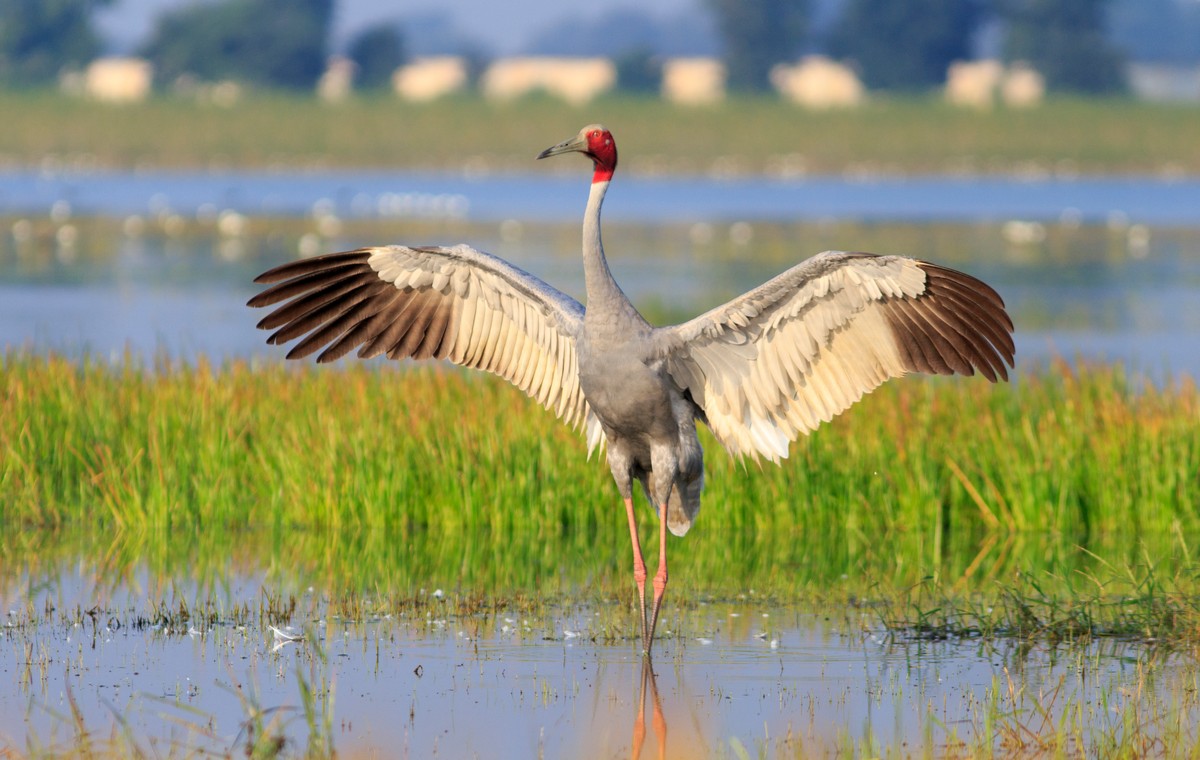
The Sarus Crane Grus antigone, the world’s tallest flying bird, faces a steady population decline in Gondia. Known for its graceful courtship dances and lifelong pair bonds, this bird relies heavily on wetland habitats to feed and breed. Photo courtesy: Kanhaiyalal Udapure
“Our team of forest officers, NGO volunteers, local farmers, and Sarus Mitras (friends of the Sarus) conducted the species’ population estimation in Gondia by surveying their roosting sites. This year, we recorded 30 mature individuals, compared to 34 in 2024. Without urgent interventions, the population is at risk of vanishing from the region,” explains Ladekar, who is a 2024-25 WCT-BEES Grants Awardee and a former Mud on Boots Project Leader. I can sense an undercurrent of worry in his otherwise calm voice.
For the world’s tallest flying bird, local extinction looms large in Gondia district – the only location in Maharashtra where the Sarus Crane Grus antigone still breeds. Once upon a time, the bird could be found across the country’s length and breadth – from the Gangetic plains in the north to the Godavari river in the south, and from West Bengal and Assam in the east to Gujarat in the west. However, they have disappeared from most of their historical range. From Maharashtra, there are records of the species from the early 1900s from various locations such as Santacruz and Bandra in Mumbai, and reports of sightings in Panvel, Tembhi, and Daman in the late 1800s. Today, Gondia is the last true bastion of the Sarus in the state.
The survival of this crane is tied to the health and existence of wetlands and marshes. That said, it also lives alongside humans in artificially formed water-logged areas including paddy fields. Perhaps it’s this ability to adapt to human-dominated landscapes that has played a role in its survival thus far. But equal credit goes to the people who live alongside the Sarus. In Gondia, as in many parts of India, Sarus Cranes hold a special cultural significance. They symbolise fidelity, prosperity, and harmony with nature. Recent years have witnessed a significant increase in the tolerance of local communities towards the birds’ presence in agricultural fields. Thus, a bouquet of factors including culture, adaptability, outreach and conservation has ensured their persistence in Gondia.
But the Noose Tightens
In Gondia, a land that once harboured over 2,500 small wetlands is now witnessing large-scale encroachment and habitat loss. Overexploitation of wetlands and their conversion for agriculture, urbanisation, and more are causing wetland habitats to shrink and disappear. “With shrinking wetlands, Sarus Cranes have shifted their nesting to paddy fields.” However, Ladekar points out, “owing to their sensitive nature, several pairs abandoned nesting this year because of human disturbance”. It gets worse.
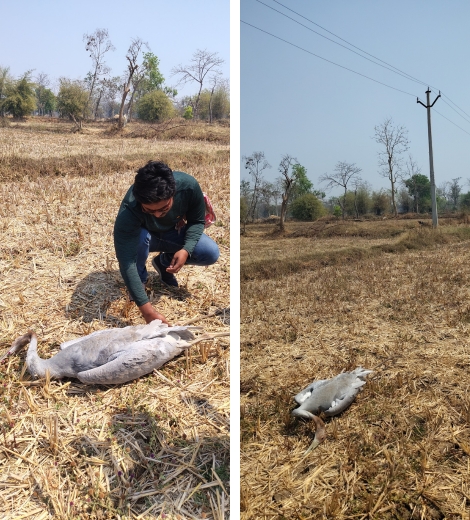
Shashank Ladekar (left) examines the carcass of an electrocuted juvenile Sarus Crane. These young Sarus Cranes died after colliding with overhead wires in Gondia (left and right), a tragic reminder of how power lines continue to threaten the species across its range. Photo courtesy: Shashank Ladekar
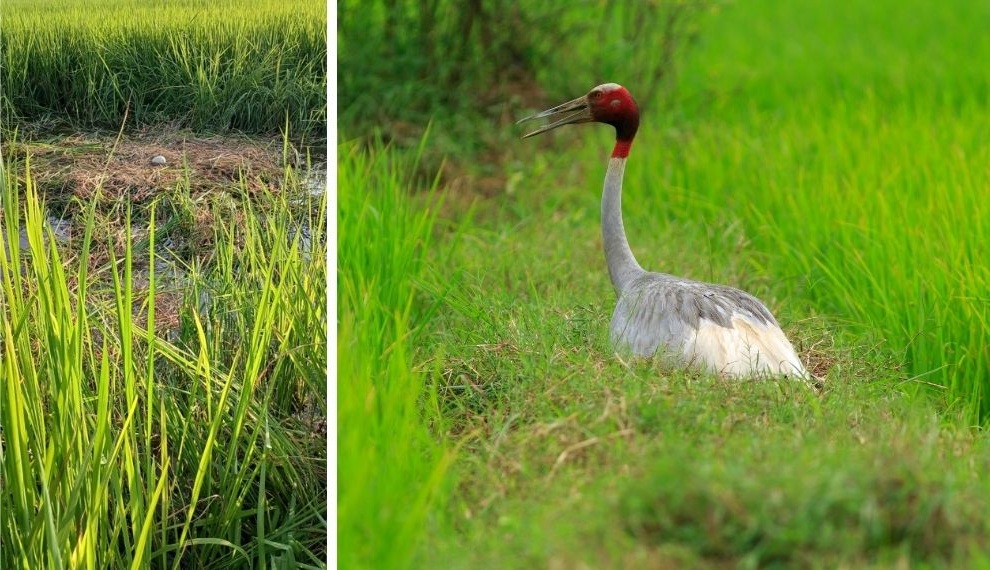
A Sarus Crane nesting in a paddy field (right), and an abandoned nest (left). Habitat loss, wetland degradation, and increasing human pressures threaten the species’ chances of survival. Photo courtesy: Shashank Ladekar
“Unfortunately, electrocution has emerged as a serious risk for Sarus Cranes. Young chicks, when preparing for their first flight, are highly vulnerable. Even small obstacles such as overhead wires can cause fatal injuries. Such collisions, though less reported, are an additional threat to the survival of the species,” he adds.
More and more power transmission lines can be seen crisscrossing overhead in Gondia. Farmlands that function as critical seasonal wetlands for Sarus Cranes to rear chicks, are not spared. Even insulated wires are too much for the sensitive birds to withstand upon impact. “These private transformers and wire networks create a ‘web’ of collision risk,” laments Ladekar. The electrocuted birds are a stark reminder of the challenges the species is facing in Maharashtra.
Indiscriminate pesticide use adds to the death toll. Toxic agrochemicals poison the soil, water, and food of the Sarus, severely impacting survival and breeding success. Toxins accumulate and build up in birds in their wetland habitats. Their diverse diet, which includes crops, varied plants, insects, lizards, snakes, bird eggs, frogs, snails, earthworms, and even rats, all are susceptible to contamination. Down the years, several pairs of Sarus Cranes have perished unnoticed in Gondia and other parts of Maharashtra.
The climate crisis intensifies the challenges, mounting the pressure on Sarus populations. Erratic rainfall and warming temperatures are already altering wetland ecosystems and disrupting seasons, making breeding habitats progressively less suitable.
Putting Communities at the Forefront of Conservation
Sarus Cranes require sustained conservation efforts to ensure their survival in Maharashtra, and without the involvement and support of communities, their survival chances are bleak.
Local NGOs such as Sustaining Environment And Wildlife Assemblage (SEWA) and Save Ecosystem And Tiger (SEAT), together with the Bombay Natural History Society (BNHS), have been working to protect and conserve the Sarus Crane and its wetland habitats in the Vidarbha landscape for over two decades. They have persistently built support for Sarus conservation by placing Biodiversity Committees at the centre of village governance.
Conservation and awareness efforts have manifested inspiring levels of tolerance and co-existence between Gondia’s farmers and the Sarus Cranes
“The people who live in these areas understand the bird’s behaviour, movements, and nesting patterns far better than anyone else. By involving them directly, we are building a community-driven protection system,” explains Ladekar.
In the past year, the Wildlife Conservation Trust’s WCT-BEES Grants Programme has helped him establish Biodiversity Committees in 10 villages in the Gondia district, organise community awareness programmes, and sensitise villagers about the value of wetlands and the Sarus Cranes.
Furthermore, Sarus Mitras and local informers, who are tasked with monitoring each nesting site, prevent outside disturbances, and actively support farmers in whose fields the cranes nest. After fledglings have successfully dispersed from their fields, farmers are felicitated. “Their traditional knowledge, combined with scientific guidance, ensures that efforts to save this majestic bird are deeply rooted in the community itself,” says Ladekar.
Already, the conservation and awareness efforts have manifested inspiring levels of tolerance and co-existence between Gondia’s farmers and the Sarus Cranes that nest in their paddy fields. It is a common sight to witness the Sarus pairs in fields with farmers respectfully keeping their distance. The birds even feed on the crops, costing the farmers. But the cultural reverence for the bird and increased awareness are gradually bringing about a positive shift in Gondia. Local farmers now view Sarus presence in their fields as a matter of pride rather than a nuisance, which is crucial for long-term conservation.
Will such attitudes pave the way for the revival of the species in Maharashtra?
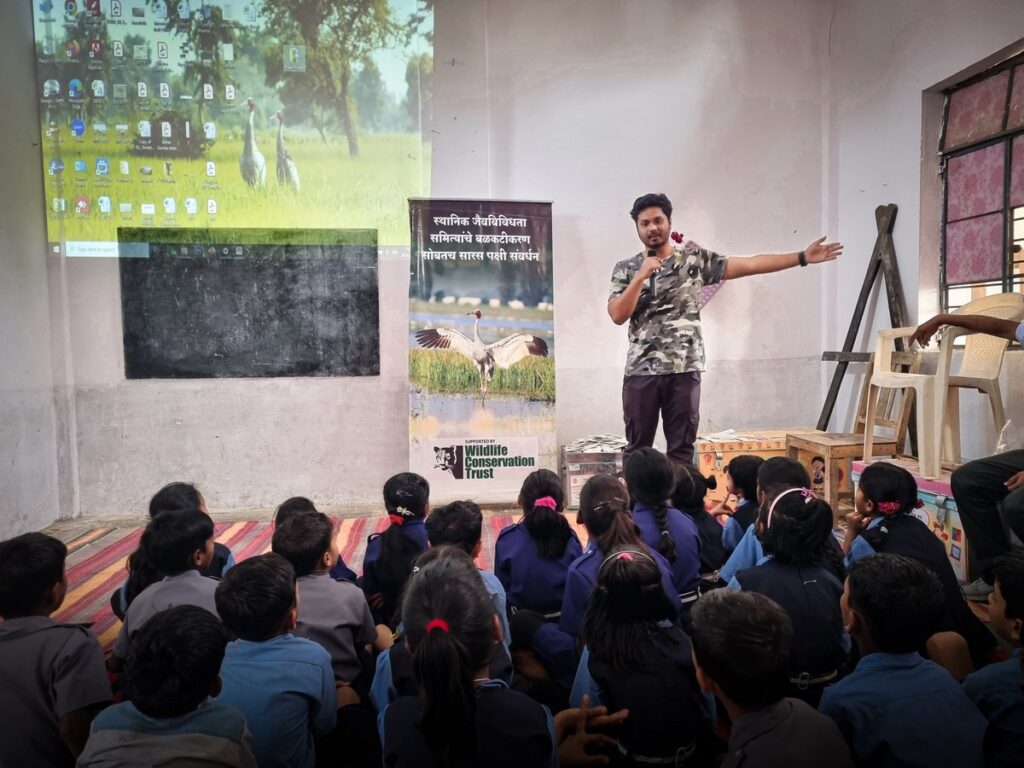
An outreach and sensitisation programme is underway at a school in Gondia, where Shashank Ladekar teaches children that protecting Sarus Cranes is crucial for maintaining healthy wetland ecosystems. Photo courtesy: Shashank Ladekar.
This article was originally published in the December 2025 issue of Sanctuary Asia.
About the author:
Purva Variyar leads the WCT-Biodiversity, Ecosystems, and Endangered Species Grants Programme (WCT-BEES Grants Programme), and heads the Communications vertical at the Wildlife Conservation Trust. WCT provided funding support for Shashank Ladekar’s project on Sarus Crane conservation in Gondia in 2024-25.
Disclaimer: The author is associated with Wildlife Conservation Trust. The views and opinions expressed in the article are her own and do not necessarily reflect the views and opinions of Wildlife Conservation Trust.