
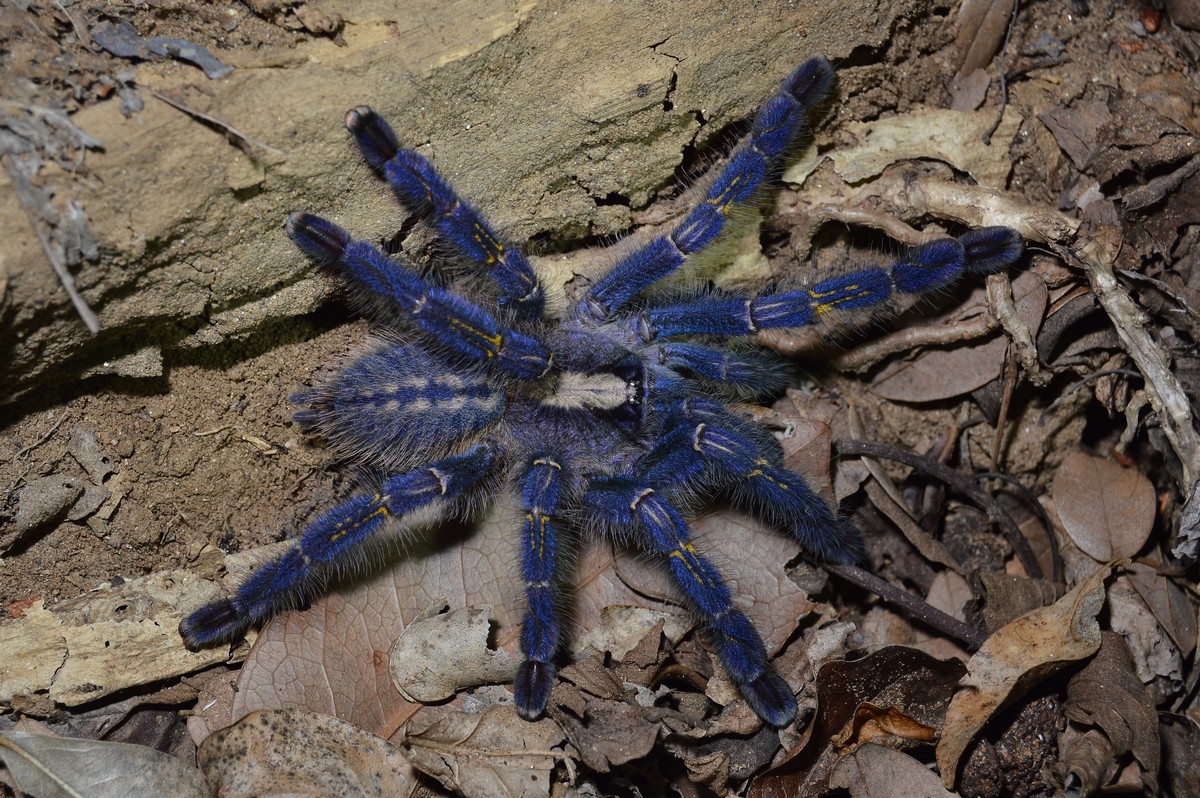
The peacock tarantula, also known as the Gooty tarantula – because in 1899 one was inadvertently transported in a wood pile to a railway timber yard in Gooty, Andhra Pradesh, where it was later sighted, leading to the species’ discovery – is particularly at risk from traders, breeders, and hobbyist exotic animal keepers. Photo credit: Arvind Aathia
There she was, visible only by her hairy legs protruding from a tree hollow on a boulder-strewn hill somewhere in the Eastern Ghats. Suddenly, she emerged out of her cavity, fully exposing herself, and examining her surroundings with her eight sharp eyes. A peacock tarantula at last. Perhaps vibrations on the trunk caused by the movement of an insect, millipede, gecko, or something else had lured her out of her arboreal abode. Whatever it was, I was grateful. The dazzling, almost metallic purple of her body, flecks of bright yellow, and a striking pattern along her back were there for us to marvel at. Her sheer size was breathtaking and commanded respect. The sight of this critically endangered spider that has been recorded in the wild only a handful of times since it was first scientifically described in 1899, made the climb up what felt like a million boulders, through darkness on an extremely humid night, drenched in sweat and out of breath, entirely worth it. The peacock tarantula Poecilotheria metallica is critically endangered according to the IUCN Red List of Threatened Species. The demand for it in the exotic pet trade is one of the main drivers of the species’ population decline in the wild.
I am in Tamil Nadu with wildlife biologist Gautam Kadam, whose heart beats for spiders. Kadam is working to learn more about the little-known and little-studied tarantulas of India’s Eastern Ghats, and protect them. We are here to try and sight the critically endangered peacock tarantula Poecilotheria metallica and the endangered Salem ornamental tarantula Poecilotheria formosa, the main subjects of Kadam’s conservation research project supported by the Wildlife Conservation Trust (WCT) under the WCT-BEES Grants Programme.
Paradoxically, while little is known about the ecology and taxonomy of these two species, much is known about some of the major threats they face. Illegal wildlife trade being one of them. I write ‘… somewhere in the Eastern Ghats’ because I am afraid to divulge any more details about the location, because of the overwhelming demand for them in the pet trade. Unfortunately, these, and several other tarantulas, native to India, are illegally collected from the wild to feed the huge demand in pet markets in the country and worldwide. A large part of Kadam’s project is examining local illegal trade activities and hobbyist practices related to tarantula-keeping.

Gautam Kadam observes a Salem ornamental tarantula. His research is helping to shed light on previously unknown behaviours of this species. Photo credit: Santosh A.
Wildlife biologist Gautam Kadam’s heart beats for spiders. He is working to learn more about the little-known and little-studied tarantulas of India’s Eastern Ghats, and protect them. We are here to try and sight the critically endangered peacock tarantula and the endangered Salem ornamental tarantula.
“Of all spiders, tarantulas are in great demand for pet trading across the globe owing to their body size, attractiveness, and longevity. In India, which is home to over 60 tarantula species, only eight are currently protected under Schedule II of the Wildlife (Protection) Act, 1972. Despite being legally protected, both peacock and Salem ornamental tarantulas, that are found nowhere else on Earth but in the select and fragmented forests in the Eastern Ghats of southern India, continue to be pushed to extinction, not only because of the illegal wildlife trade, but also owing to habitat loss and degradation,” explains Kadam.
Interesting facts about peacock and Salem ornamental tarantulas
- There is hardly any information available on their taxonomy and ecology. Till date males of both the species remain undescribed by science.
- There have been no records of these spiders at the locations where they were first identified, since their initial discovery.
- It is likely that these species have already gone locally extinct in many areas owing to deforestation, logging, forest fires, illegal collection for pet trade, and development activities.
People’s reckless and destructive desire for possessing live wild animals is pushing many tarantula species towards extinction. According to a 2024 report by Mongabay, nearly 25 per cent of the world’s tarantula species newly discovered since 2000, have been recorded in the international pet trade. How tragic would it be to lose them forever before we even truly get to know them? As recently as 2024, four species of tarantulas, new to science, were described from India’s Western Ghats.
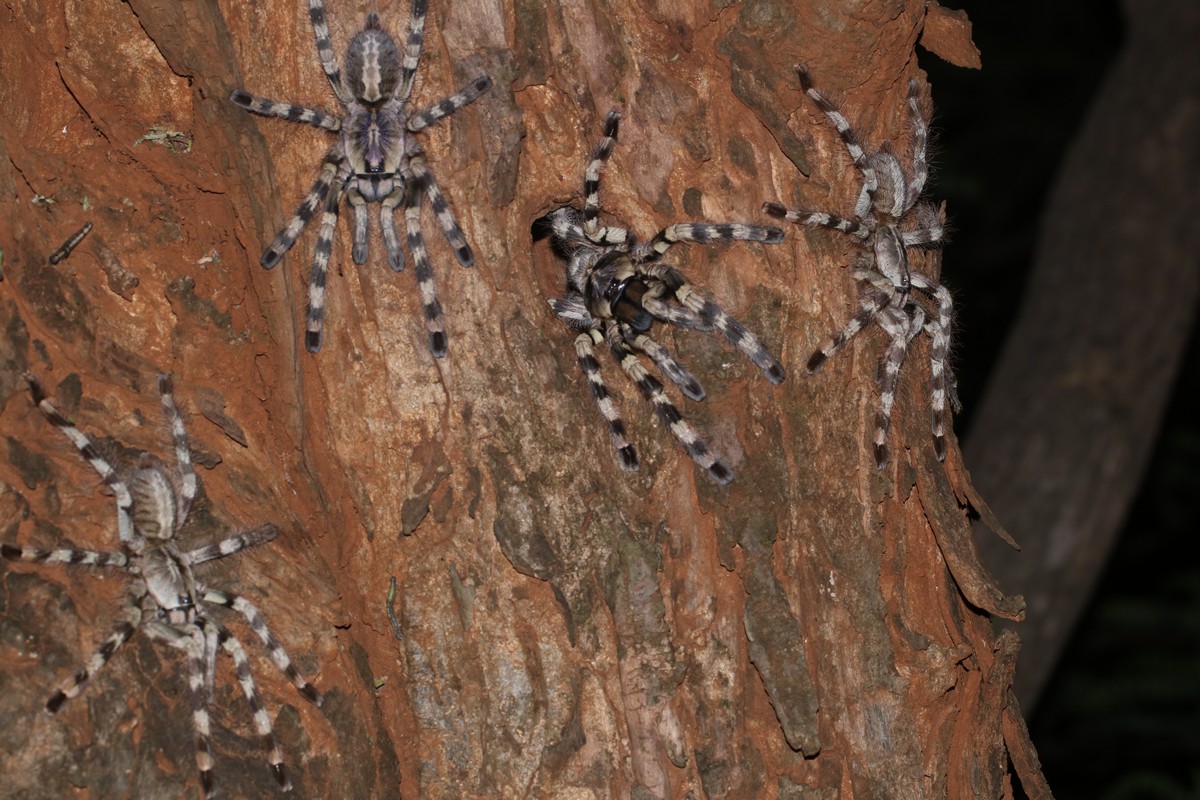
A mature female Salem ornamental tarantula (centre) surrounded by her adult daughters on the trunk of an Albizia amara tree. Photo credit: Gautam Kadam
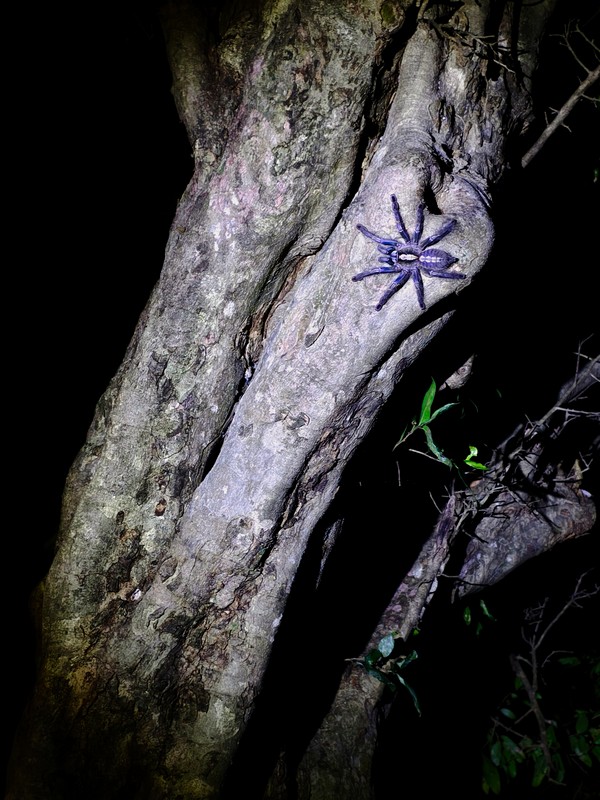
A female peacock tarantula emerges from her tree hollow at night, when these spiders are the most active. Photo credit: Purva Variyar
When Trees Go, Tarantulas Go
The peacock tarantula and the Salem ornamental tarantula, like their other ornamental tarantula counterparts, belong to the genus Poecilotherinnae, which is ancient Greek for ‘spotted wild beast’. Ornamental tarantulas are largely arboreal – tree-dwelling, preferring to live in naturally occurring cavities of specific trees in the dry deciduous and evergreen forests of India and Sri Lanka. For example, Salem ornamental tarantulas are known to prefer to live and breed in the hollows of certain trees such as Albizia amara. Peacock tarantulas are known to prefer Ficus trees and some other trees in proximity to Ficus trees, in old growth forests on hillocks.
Kadam and I walk through an Albizia amara-dominated patch close to Salem district. All the trees look alike to me. Even in the darkness of the night, Kadam is able to identify the exact trees whose cavities host Salem ornamental tarantulas. “This is a special spot for me. After almost giving up on ever finding this spider, after months of searching, I came across this patch of reserve forest by sheer accident. Given how fragmented, restricted, and degraded this species’ range is, it was a miracle. I have spent so many nights here for my study, that I could lead you to the Salem ornamental tarantulas blindfolded,” gushes Kadam.
Unlike the characteristically solitary peacock and other ornamental tarantulas, the Salem ornamental tarantula often exhibits unique social behaviour. “Often, like this, you will find a mature, large female living with her brood on the same tree, sharing the same cavity, sometimes even after the young reach adulthood. We are still to fully understand this behaviour,” Kadam explains.
“Fun fact – I have even come across Salem ornamental tarantulas sharing tree cavities with snails and cat snakes!” adds Kadam.
I gape, open-mouthed, at the striking individuals before me, with prominent light grey and deep black bands adorning their limbs. As my eyes adjust, more appear across the tree, some as small as my thumbnail, others larger than my palm. To think I had hardly expected to see even one!

Old-growth forests located on these boulder-studded hillocks are a preferred habitat of the arboreal peacock tarantula. Sadly, these forests are succumbing to human pressures. Photo credit: Gautam Kadam
Of all the spiders, tarantulas are in great demand for pet trading across the globe owing to their body size, attractiveness, and longevity. In India, which is home to over 60 tarantula species, only eight species are currently protected under Schedule II of the Wildlife (Protection) Act, 1972. Old-growth forests located on these boulder-studded hillocks are a preferred habitat of the arboreal peacock tarantula. Sadly, these forests are succumbing to human pressures.
What little records of the Salem ornamental tarantulas exist, have emerged from very few sites that I could count on the fingers of my hand. Sadly, all are located in highly degraded forests in the Eastern Ghats. Habitat destruction continues unabated mainly owing to human activities such as firewood collection and cattle grazing. The montane old growth forest habitat of the peacock tarantula is equally under immense anthropogenic pressure and continues to shrink rapidly.
“My study on the two tarantula species has led to some exciting ecological insights and taxonomic redescriptions. I plan to work closely with the Forest Department to combat illegal trade in these species and ensure habitat protection, which will hopefully lead to the establishment of small reserves dedicated to the conservation of these tarantulas, emphasising the importance of invertebrate fauna,” shares Kadam.
The fate of these fascinating arboreal tarantulas is acutely tied to the trees and their forests, which face a multitude of threats.
“Additionally, the lack of knowledge about their ecology and conservation status could further jeopardise their vulnerable populations. I wish to change that,” says a determined Kadam.
This article was originally published in the June 2026 issue of Sanctuary Asia.
About the author:
Purva Variyar leads the WCT-Biodiversity, Ecosystems, and Endangered Species Grants Programme (WCT-BEES Grants Programme), and heads the Communications vertical at the Wildlife Conservation Trust. WCT provided funding support for Gautam Kadam’s project focused on the peacock tarantula and Salem ornamental tarantula in the Eastern Ghats in 2024-25.
Disclaimer: The author is associated with Wildlife Conservation Trust. The views and opinions expressed in the article are her own and do not necessarily reflect the views and opinions of Wildlife Conservation Trust.