
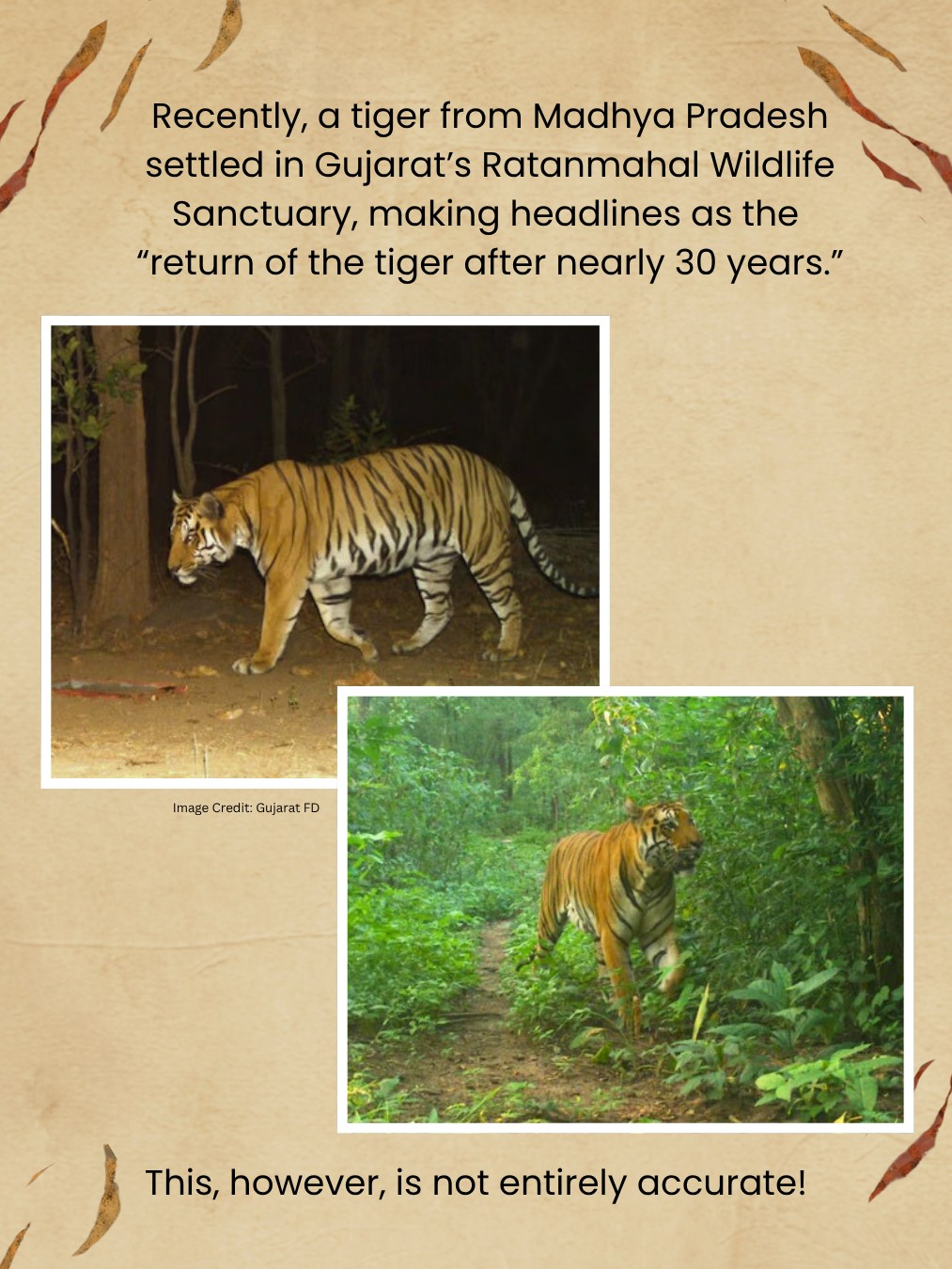
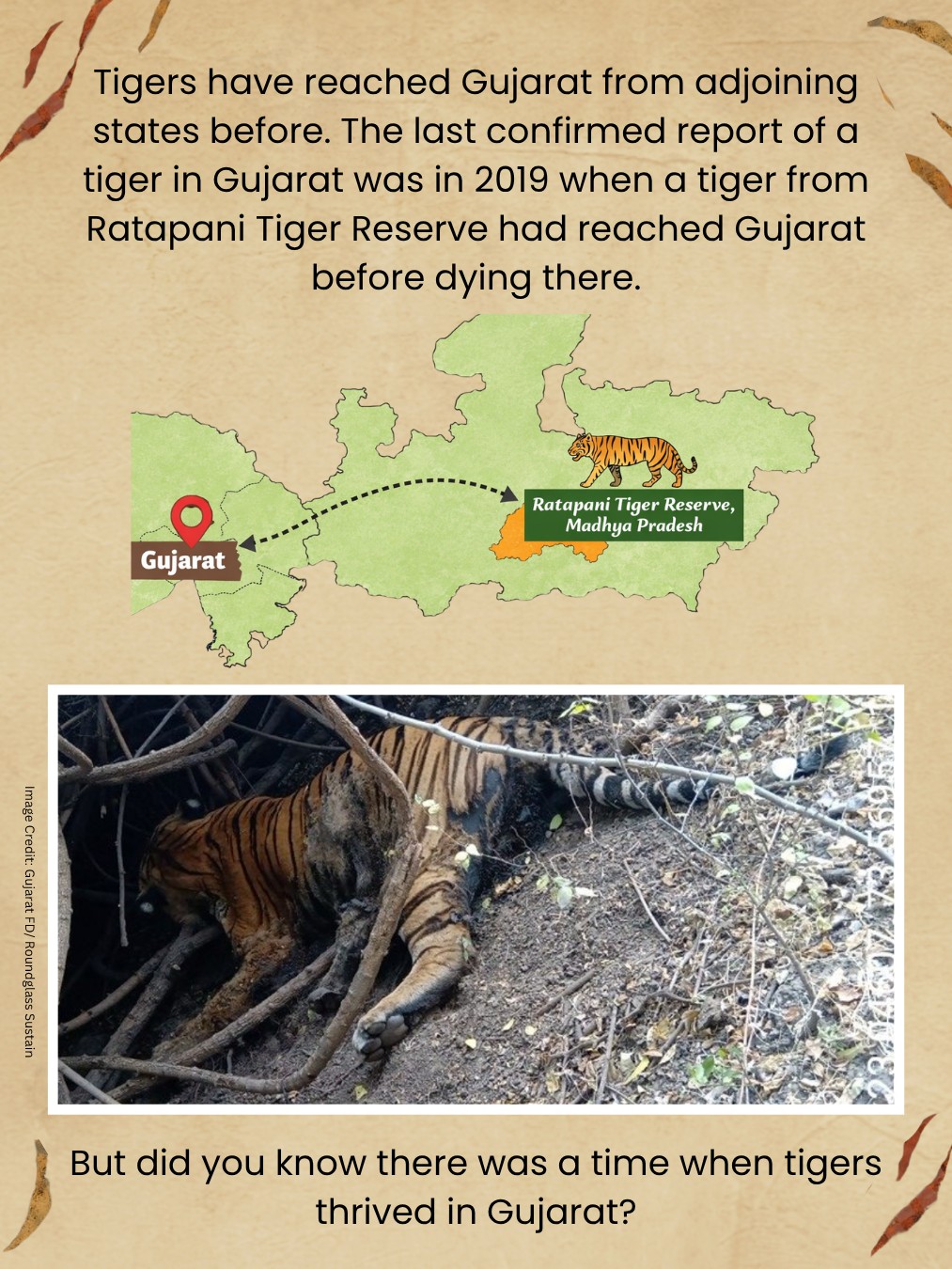
Recently, a tiger that entered Gujarat from Madhya Pradesh and settled down in the Ratanmahal Wildlife Sanctuary has been in the news. It has been widely reported as the return of the tiger to Gujarat after nearly 30 years. However, that reporting is slightly inaccurate because a tiger from Ratapani Tiger Reserve (MP) had also reached Gujarat in 2019 before dying there. Nonetheless, there was a time when Gujarat, the state that immediately conjures images of the Asiatic lion, was home to a sizable tiger population.
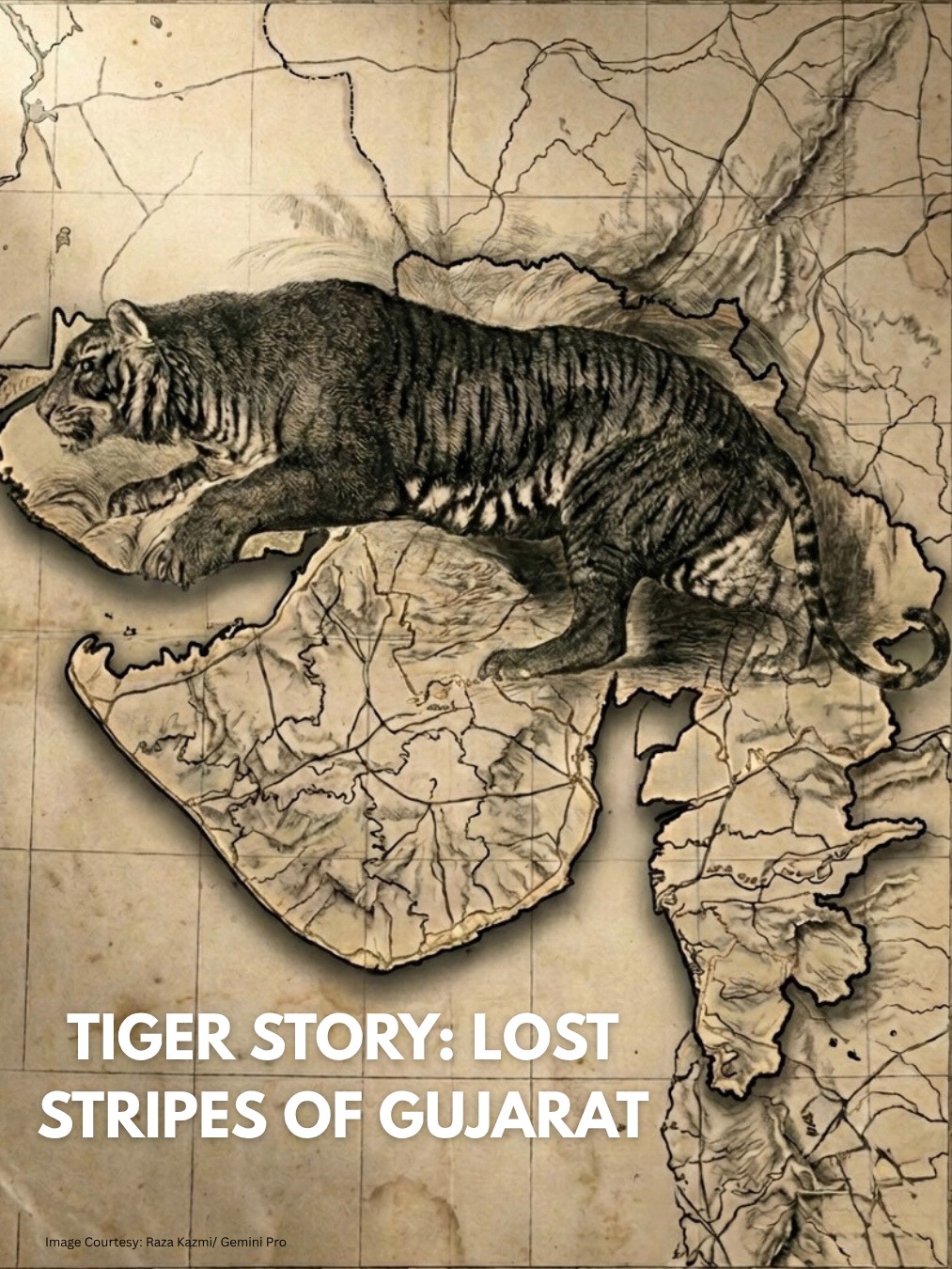
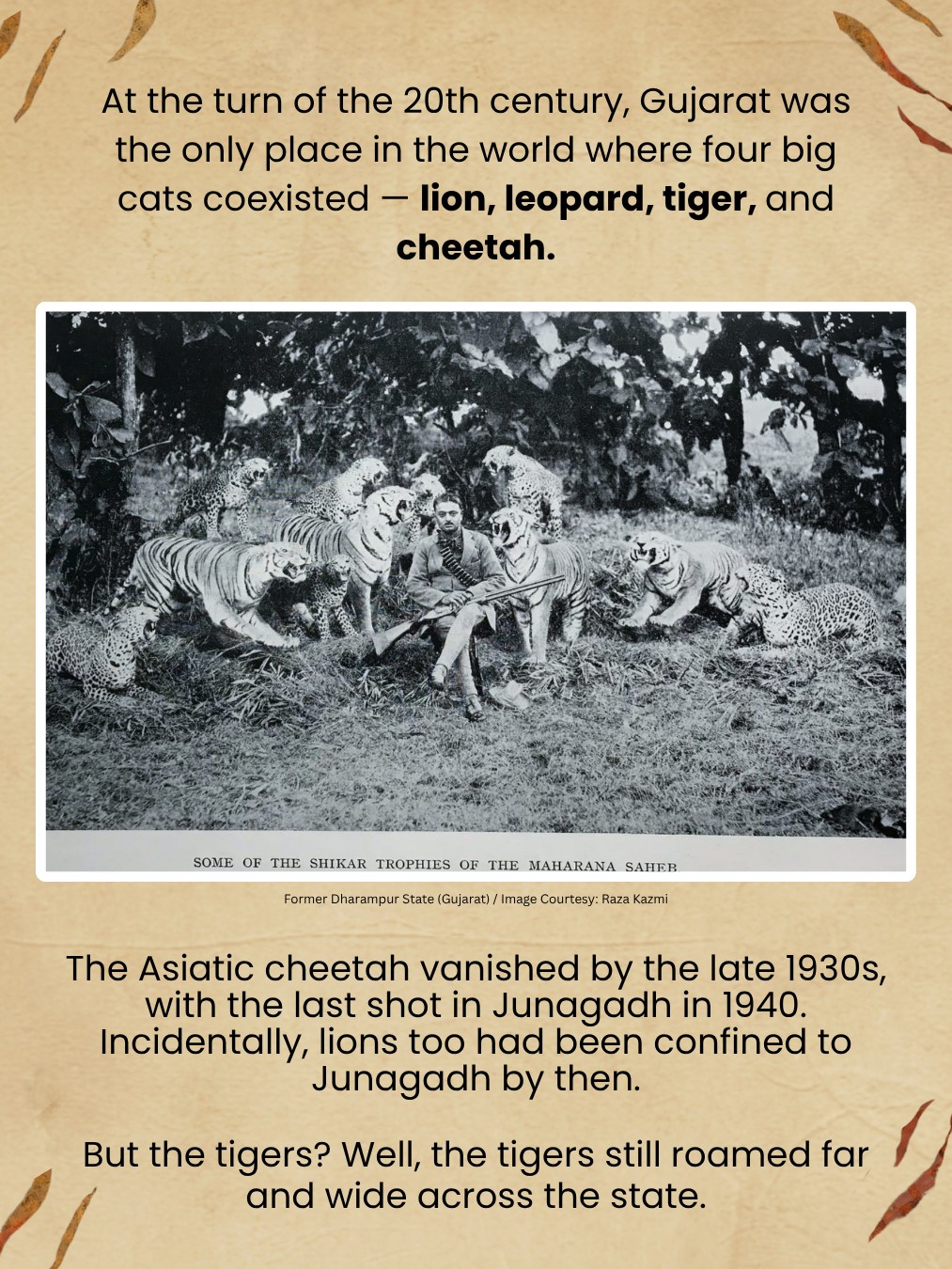
At the turn of the 20th century, Gujarat was the only place in the world where you could hope to see four big cats — lion, leopard, tiger, and cheetah. The first two still live in Gujarat. Unfortunately, the Asiatic cheetah (Acinonyx jubatus venaticus) faded away from the state by the late 1930s, when the last one was shot in Junagadh district in 1940. But what about Gujarat’s tigers? What happened to them?
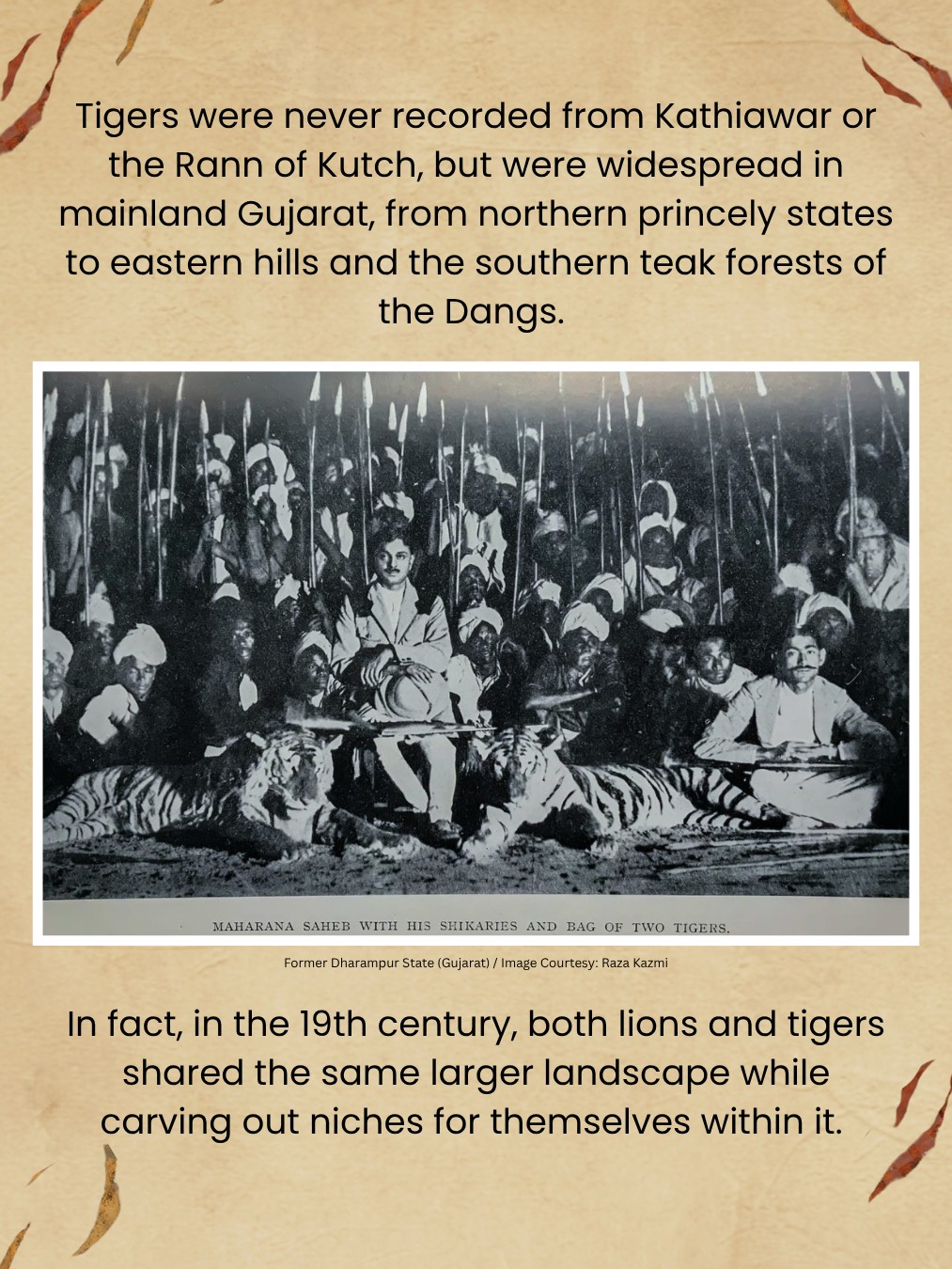
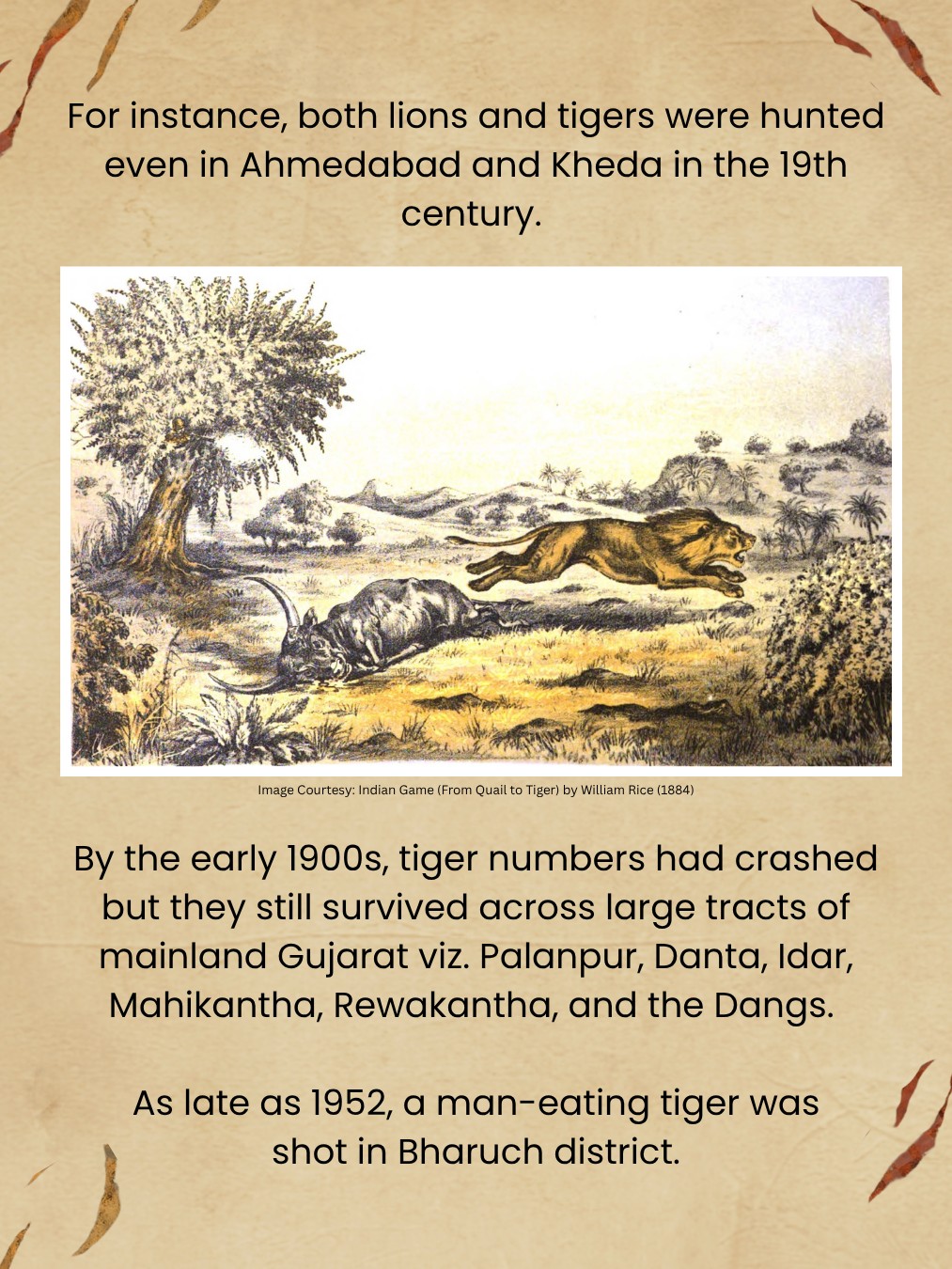
Gujarat can be geographically divided into three distinct entities: the Kathiawar Peninsula, the salt pans of the Rann of Kutch that lie to its north, and the so-called “mainland Gujarat” with Rajasthan to its north and Maharashtra to its south. Tigers are not recorded from the Kathiawar Peninsula or the Rann; however, they were widespread in mainland Gujarat. In the 19th century, the British-era districts of Ahmedabad and Kaira (Kheda) seem to have been the frontier for both lions and tigers in Gujarat. Both cats were recorded and hunted there, though lions were eventually exterminated in the early decades of the 19th century. Tigers lingered for a little longer. They were shot in areas that now fall within Ahmedabad City, such as the Rani Rupamati Mosque complex, where one was shot in the 1840s. However, by the late 1870s, tigers were gone from Ahmedabad and Kaira, and had receded to the eastern districts of the province, where they were still plentiful. For instance, in the Panchamahals district in eastern Gujarat, 22 tigers were killed in a single year (1865).
By the turn of the 20th century, even though Gujarat’s tiger numbers were a fraction of what they used to be in the 1850s, they were still common in the forests of Palanpur, Danta, Idar, and other smaller princely states in the north; the hilly tracts of Mahikantha and Rewakantha Agency in the east; and the mixed teak forests to the south, especially the Dangs. The interior districts of Surat, Baroda, and Bharuch also got an odd tiger here and there. As late as 1952, a man-eating tiger was shot in Bharuch district.
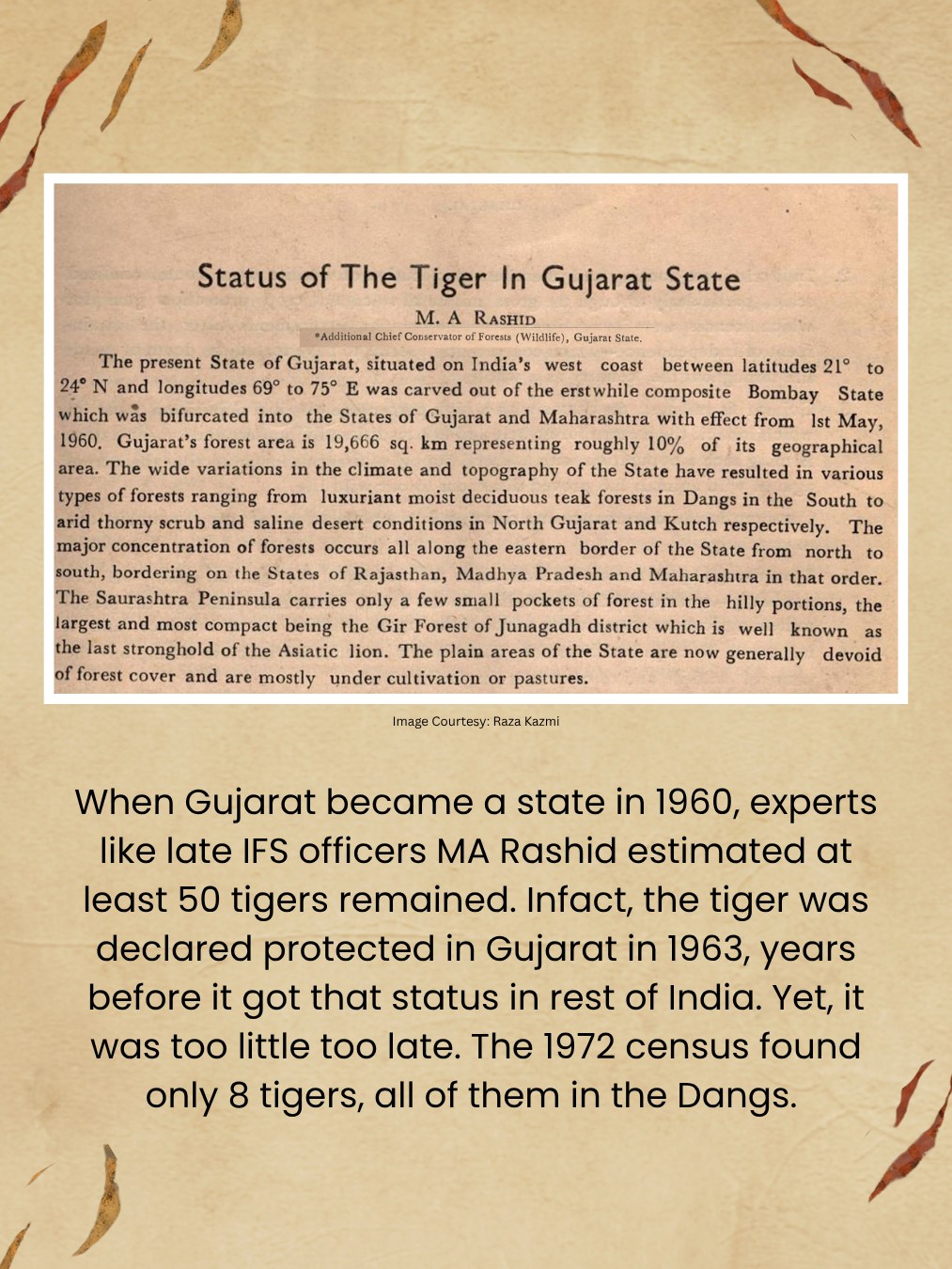
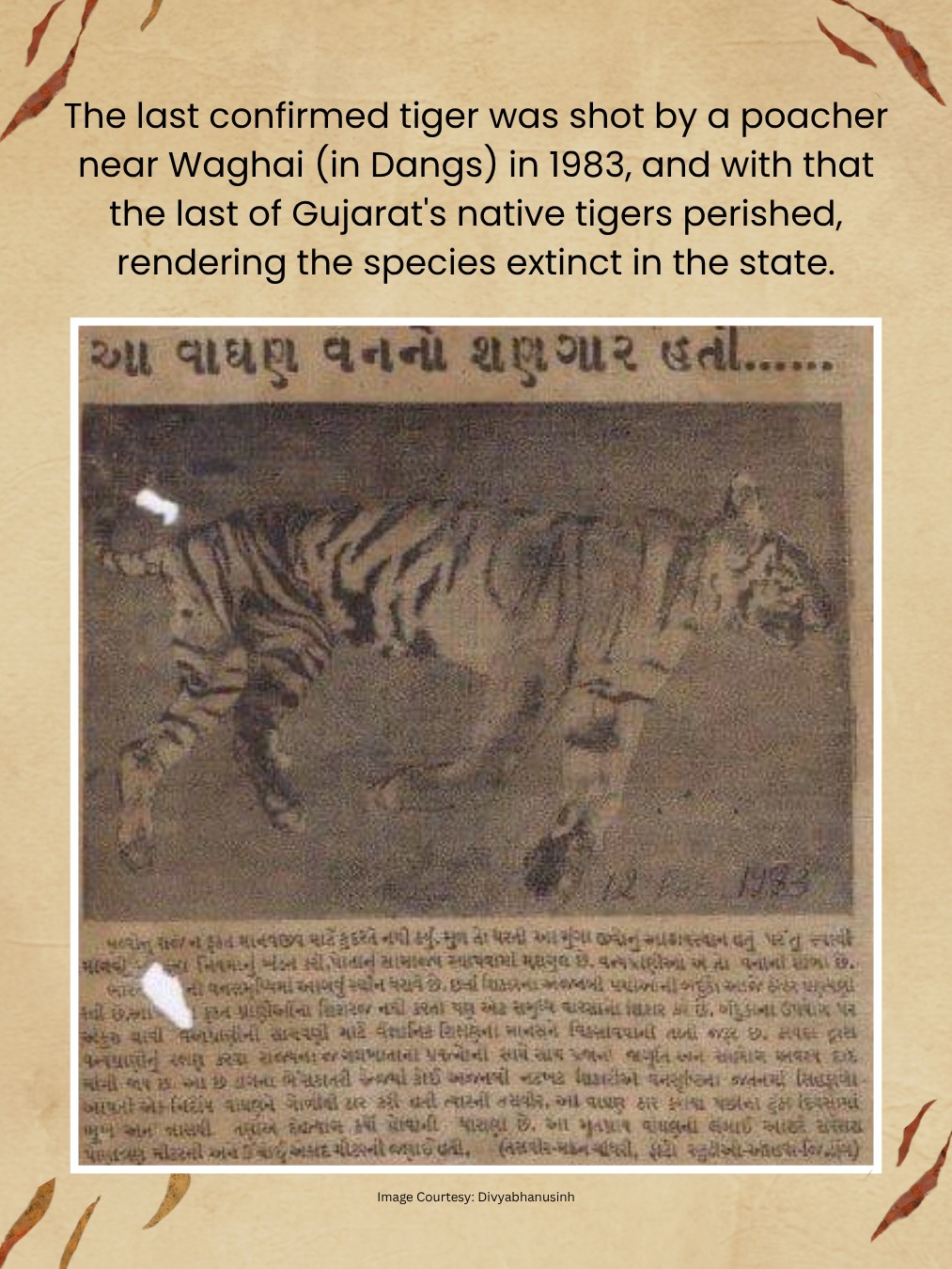
M A Rashid, one of Gujarat’s most renowned forest officers and conservationists, remarked that tigers were “fairly abundant” in multiple districts of Gujarat up to the early 1960s. While no tiger census was conducted in Gujarat until 1972, Rashid believed that there were at least 50 tigers in the state in 1960, the year Gujarat state was carved out of Bombay. A few tigers continued to be shot in Gujarat (three in 1960-61, two in 1962-63), after which the tiger was declared a protected species in October 1963. While this was a far-sighted step at the time—given that tiger hunting in India would be outlawed only in 1971 after a Delhi High Court order (later upheld by the Supreme Court)—it was already too late for Gujarat’s tigers. The first-ever tiger census in Gujarat, conducted in 1972, revealed the presence of only eight tigers in the entire state, all of them being recorded from the Dangs forest. Seven years later, the 1979 census carried out in tandem with a lion census in Gir, threw up the figure of 205 lions and a mere 7 tigers. Even with these tigers, there was a lingering doubt whether they were resident animals or transient individuals migrating into Dangs from the forests of Melghat in Maharashtra (with which Dangs shared a forest corridor). The last reported tiger in Dangs was shot by a poacher near Waghai in 1983. And with that, the vagh of Gujarat became locally extinct.
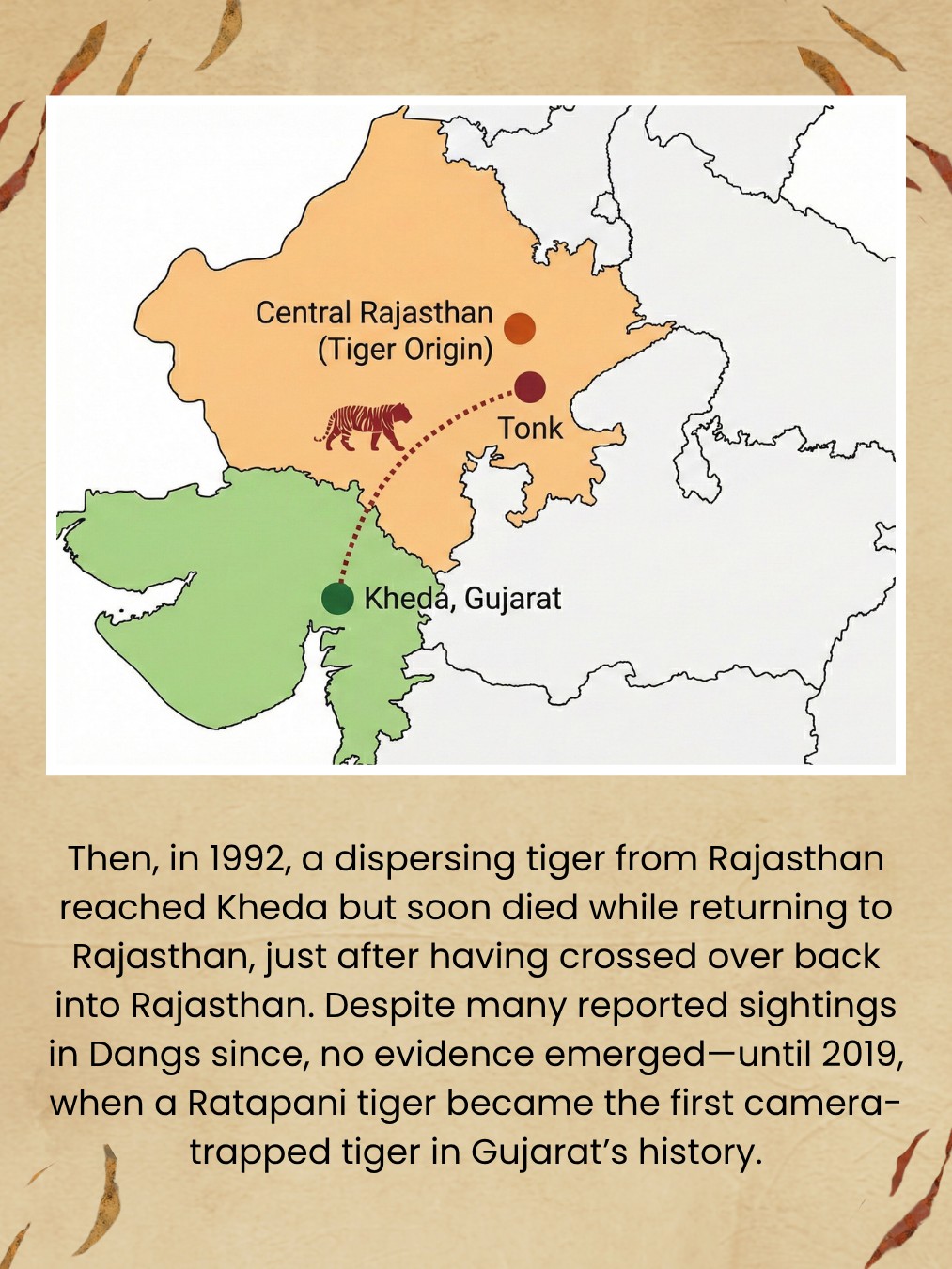
In 1992, a tiger was reported from Kheda, their old haunt, which had last recorded a tiger more than a century ago. It was a dispersing male tiger from Rajasthan that had crossed into Gujarat’s Banaskantha district. Unfortunately, it was soon found dead just across the border in Rajasthan as it marched back to its parent state. Since then, numerous tiger sightings have been reported in Dangs, but no conclusive evidence of their presence has ever been found. It was only in 2019 that the Ratapani tiger became the first tiger to be camera-trapped in Gujarat’s history.
It is interesting to note that at the turn of the 20th century, while the lion had dwindled to barely a handful of animals in Junagadh, its striped cousin was fairly abundant in Gujarat. However, in a curious case of historical irony, more than a century later, the fortunes of the two big cats have undergone a complete reversal, with the lion doing well in the state while the tiger has disappeared.
About the Author: Raza Kazmi is a conservationist, wildlife historian, storyteller, and researcher. He is a Conservation Communicator at WCT and writes in both English and Hindi languages. His writings appear in national newspapers, online media houses, magazines and journals, and various edited anthologies. A recipient of the New India Foundation Fellowship for 2021, he is currently writing a book tentatively titled ‘To Whom Does the Forest Belong?: The Fate of Green in the Land of Red’.
Disclaimer: The author is associated with Wildlife Conservation Trust. The views and opinions expressed in the article are his own and do not necessarily reflect the views and opinions of Wildlife Conservation Trust.
Your donations support our on-ground operations, helping us meet our conservation goals.